ArchiveProject 03 / 10UX/UI / Product / Interactive
Doublepoint
An IDBM industry project with Doublepoint, a touch-detection startup: finding accessible uses for their wearable sensor technology to make people with fine motor disabilities more independent.

[01] Overview
During the IDBM Industry Project course at Aalto University, our interdisciplinary team collaborated with Doublepoint, a startup specializing in touch detection technology. Our goal was to find innovative, accessible applications for their wearable sensors, specifically to enhance independence for individuals with fine motor disabilities.
[02] Process
Seven months, three continents, seven user groups.
The 7-month design process involved an immersive exploration of the startup and XR industry landscape, followed by user needs discovery and research on inclusive technologies.
Our team conducted global industry immersion trips to California and Tokyo, engaging with professionals and attending XR-related events. We concluded that while the XR industry is heavily dominated by big tech, there is a massive unserved niche market in accessibility.
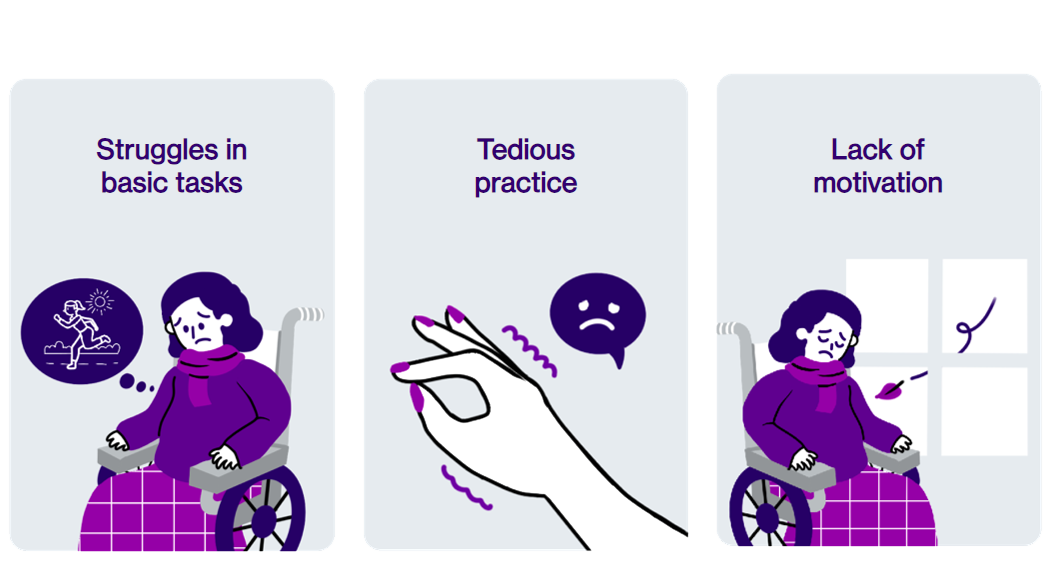
Applying the Double Diamond framework, thorough field research and interviews were conducted with seven diverse user groups and associations. Thematic analysis revealed three main design directions for the touch technology: independent home life, safety alerts, and learning / rehabilitation.
[03] Evaluation
Three directions, tested for desirability, feasibility and viability.
- 01
Smart home
Controlling smart home environments using wrist gestures. Cost barriers and financial accessibility made this unfeasible for our target demographic.
- 02
Safety alerts
Pinch-to-trigger emergency alerts. Integrating with the wider medical service system made this unfeasible on a startup timeline.
- 03
Rehabilitation
Using the touch technology in gamified rehabilitation. Deemed the most desirable, feasible and viable direction after evaluation with users.
Chosen direction
How might Doublepoint's touch detection technology make people with fine motor disabilities more independent?

[04] Solution
Gamified physiotherapy, controlled with a smartwatch.
We designed a gamified physiotherapy concept where users with fine motor disabilities carry out their daily exercises by playing a game. The game is controlled with specified hand gestures (like pinches or clenches), tracked entirely by a standard smartwatch running Doublepoint’s touch algorithm.
The algorithm is heavily customizable, meaning the system can register a “clench” even from users with very limited muscle power. We prototyped this tap-based game and showcased it at events like the Impact Gala and Service Design Day, receiving highly positive feedback.


[05] Business model
The business model revolves around licensing an Accessibility Touch SDK to game developers and physiotherapy platforms (like Rehaboo). B2B clients integrate touch detection into their own physiotherapy experiences, without Doublepoint needing to develop the games in-house.
Because the SDK already targets the Unity game engine, pushing it toward accessibility creates a rapid go-to-market strategy that bypasses the saturated consumer mobile gaming space.
